Studio · Pricing
A pricing-page checklist
25 checks for a SaaS pricing page, most with a dated example from a public teardown: the first screen, plans, annual and usage prices, trials.
How to run it
- Open the page as a stranger: a private window, signed out, no saved currency or plan.
- Read it at two widths: 1440 px, then 390 px or your own phone.
- Answer as the buyer sees it, not as you know it. If you have to explain it, the answer is no.
- Ring every no and every not sure, then choose your first three.
The checks are also a free A4 PDF, with a one-line way to test each one and room for your first three: take the self-check with you.
A. The first screen
The first screen is the one every visitor sees, and on a phone it is small.
A1. On a phone, does every plan’s price appear within the first two screens?
Seen 19 October 2026: n8n’s plans are a sideways carousel at 390 px, and the first screen shows no price. The n8n teardown, change 7.
A2. Does each plan say who it is for, in a few words, above its feature list?
A3. Is the unit of each price plain: per seat, per workspace, per month, per use?
Seen 19 October 2026: Buffer prices by channel; at 390 px its stepper says only “Channels”, and the definition is in the FAQ. The Buffer teardown, change 7.
A4. Is the currency named, and is money written one way everywhere?
Seen 19 October 2026: n8n’s cards write “20€” and its FAQ “4,000 EUR”, and no line says which currencies it bills in. The n8n teardown, change 9.
A5. Does the page say whether tax is included, and does the price include every charge everyone pays? (source 1)
B. The plans
A buyer should find their plan with one question, and see what the next plan adds.
B1. Does each plan above the first lead with what it adds to the plan below?
Seen 19 October 2026: n8n’s Business card leads with executions; what sets it apart, such as SSO and Git, comes lower down. The n8n teardown, change 6.
B2. Do the plans split along one line the buyer already knows: team size, usage, hosting or support?
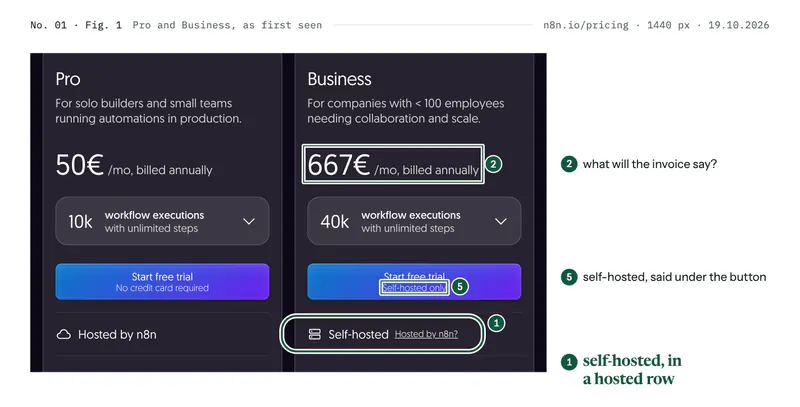
Seen 19 October 2026: n8n’s four cards mix two ladders: hosted by n8n, and self-hosted. The n8n teardown, change 1.
B3. Does every cell in the comparison table tell this buyer something?
Seen 19 October 2026: n8n’s Cloud tab has a row that reads N/A in all three columns. The n8n teardown, change 10.
B4. Does the free plan’s card follow the page’s pickers, and state its limit in the buyer’s units?
Seen 19 October 2026: Buffer’s paid cards
re-price at four channels, but Free still says “Connect up to 3 channels”. The Buffer teardown, change 6.B5. Can an unsure buyer tell which plan to start on, and why?
C. Annual, usage and AI
Every figure a buyer has to work out alone is a question they take away with them.
C1. Beside every “billed annually” price, is the amount charged each year printed? (source 1)
Seen 19 October 2026: n8n shows 20€, 50€ and 667€ “/mo, billed annually”; the yearly amount appears nowhere. The n8n teardown, change 2.
C2. Is the saving for paying yearly said one way, and does the arithmetic hold?
Seen 19 October 2026: Buffer’s cards say “save 2 months”; its FAQ says “a 20% discount”. The Buffer teardown, change 10.
C3. If the price depends on usage, can a visitor estimate their own usage on the page?
Seen 19 October 2026: n8n’s sizing example is in its FAQ, behind a click, more than eight screens below the first price. The n8n teardown, change 4.
C4. Does each plan say what happens at its limit: a stop, a slowdown, an overage charge or an upgrade?
Seen 19 October 2026: n8n’s quota answer covers Business and Enterprise; nothing says what happens when Starter or Pro reach theirs. The n8n teardown, change 8.
C5. If AI features use credits, are the credits per plan, a typical task’s cost and the price of more all shown?
Seen 19 October 2026: Figma’s AI credits
add-on shows no price on its pricing page, and its help article’s Make examples are floors, such as “100+”. The Figma teardown, change 1 and change 3.
D. Trials and the next step
The button is a promise. The page after it, and the day the trial ends, have to keep it.
D1. Does each button say what it starts: a trial of which plan, for how long?
Seen 19 October 2026: Buffer’s Essentials and Team buttons both start a trial of Team, and the pricing page doesn’t say so. The Buffer teardown, change 1.
D2. Is “card required” or “no card needed” said beside the button, not only in the FAQ?
Seen 19 October 2026: n8n’s Business trial needs a card; the line under its button says only “Self-hosted only”. The n8n teardown, change 5.
D3. Does the form after the click keep the button’s words, the plan and the price?
Seen 19 October 2026: Buffer’s trial and free buttons open the same form, which never says trial, plan or price. The Buffer teardown, change 3.
D4. Does the page say what happens when the trial ends: the plan you land on, and what you lose?
Seen 19 October 2026: Buffer’s FAQ says channels over the free limit are locked after a trial; nothing near the stepper says so. The Buffer teardown, change 4.
D5. Are renewal and cancelling said in plain words near the price? (source 1, source 2)
E. Words, phone and checkout
Small mismatches between the card, the docs and the checkout can read as risk.
E1. On a phone, are the switch, pickers and buttons easy to hit, and the small print readable? (source 3, source 4)
E2. Does every big word carry its condition: “unlimited” with its limit, “all plans” with its exceptions?
Seen 19 October 2026: Figma’s banner says AI add-ons are “available for all plans”; its help article says paid plans, admins only. The Figma teardown, change 8.
E3. Do names of plans, features and limits match across the pricing page, the product, the docs and the invoice?
Seen 19 October 2026: Figma’s seat cards show Make only as an icon; the words are in the FAQ. The Figma teardown, change 7.
E4. Are the questions buyers ask before paying answered on the page: invoices, currency, tax, refunds, cancelling?
E5. Does the checkout charge the amount, currency and period shown on the card that was clicked?
If any of your buyers are consumers
Three checks, A5, C1 and D5, touch rules on showing prices and renewals. Two pointers:
- UK. The Competition and Markets Authority’s summary asks for the total price, including mandatory charges such as VAT. For a minimum term: the total for the term, or the monthly price with the number of months (source 1).
- US. Federal law on online subscriptions asks for the material terms before billing details are taken, express informed consent, and a simple way to stop the charges (source 2).
Pointers to the texts, not legal advice: your own counsel decides the wording where you sell.
Where these checks come from
Each check is something I look for in a pricing or checkout teardown. The examples come from three public teardowns, each a page as it stood when I captured it on 19 October 2026: n8n’s pricing page, Buffer’s signup flow and how Figma explains what Make costs. The pages may have changed since. I have no connection with any of the three companies.
Take the self-check with you
The same 25 checks as an A4 PDF, to print or to mark up in any PDF reader: yes, no or not sure for each, a one-line way to test it, and a box for your first three changes.

quietlybuild Studio · PDF, A4 · free
Pricing page self-check
Twenty-five checks for a pricing page: yes, no or not sure, a one-line test for each, and room for your first three changes.
When you want the checks run for you
The pricing and checkout teardown runs these checks on your own page and checkout, then goes further: plans and packaging, upgrade paths, trial and annual logic, how your AI features are metered, and two or three experiments to run next.
Sources
- Competition and Markets Authority, “Providing clear and accurate information about prices: summary”, gov.uk, updated 7 January 2026, read on 20 October 2026: the total price in an invitation to purchase, mandatory charges, and minimum-term prices. It is written for consumers.
- 15 U.S. Code § 8403, “Negative option marketing on the Internet”, Legal Information Institute, law.cornell.edu, read on 20 October 2026: disclosure before billing details, express informed consent, and simple mechanisms to stop recurring charges.
- W3C, “Understanding Success Criterion 2.5.8: Target Size (Minimum)”, w3.org, read on 20 October 2026: pointer targets of at least 24 by 24 CSS pixels, with exceptions, at Level AA.
- W3C, “Web Content Accessibility Guidelines (WCAG) 2.2”, W3C Recommendation 12 December 2024, w3.org/TR/WCAG22, read on 20 October 2026: Success Criterion 1.4.3, text contrast of at least 4.5:1, with exceptions.
- quietlybuild, “Ten changes to n8n’s pricing page”, quietlybuild.in/teardowns/n8n-pricing, captured 19 October 2026.
- quietlybuild, “Ten changes to Buffer’s signup flow”, quietlybuild.in/teardowns/buffer-signup, captured 19 October 2026.
- quietlybuild, “Ten changes to how Figma explains what Make costs”, quietlybuild.in/teardowns/figma-make-ai-credits, captured 19 October 2026.
General information, not legal or tax advice. Not affiliated with n8n, Buffer or Figma; each is a trademark of its owner.
What changed in this guide
- 20 October 2026. Written, with the 25 checks of the self-check, edition
2026-10-20 , rev A.