Studio · Pricing
Pricing AI features: seats, credits and usage
How to charge for an AI feature: in the seat, as credits, or per use or outcome, with dated public examples and the four lines a pricing page owes.

Three shapes
- In the seat. One price a seat, AI included. A heavy month falls on you. Notion’s Business plan is priced this way (source 5).
- An allowance, then more. A seat with credits included, then top-ups or a budget. A heavy month falls on you up to the allowance, then on the buyer. GitHub Copilot and Figma are priced this way (sources 1 and 2).
- Per use or per outcome. The buyer pays for each action, conversation or result, so a heavy month falls on them. Salesforce’s Agentforce and Intercom’s Fin are priced this way (sources 3 and 4).
Most products mix them. Notion includes its AI features in the Business seat, and sells Custom Agents apart, at US$10 per 1,000 monthly credits after a free try (source 5).
Choose from your heaviest users
First work out the model cost of your median,
- If even the 99th percentile is small beside the seat, put the feature in the seat, and state a fair-use limit anyway.
- If the 90th percentile fits but the 99th doesn’t, include an allowance and sell more. Most users never meet the limit, and the few who do pay for what they use.
- If use swings with the work, and the buyer can count the result, charge per use or per outcome, and define the unit in words.
In the cost guide’s example, one action costs US$0.011 on Claude Sonnet 5.5, at the list price read again on 25 October 2026 (source 6). A user making 40 actions a month costs 2.2% of a US$20 seat; one making 2,000 costs 110% of it.
A credit needs an exchange rate
A credit is a private currency. A buyer can budget with it only if they can turn it into money, and into work.
- GitHub Copilot prices it in money. One AI credit is worth US$0.01, and each paid individual plan’s base credits equal its price: Pro, at US$10 a month, includes 1,000, plus a flex allotment of 500. On paid plans, code completions aren’t billed in credits, and included credits don’t carry over (source 1).
- Salesforce prices it in work. Flex Credits cost US$500 per 100,000, and an Agentforce action uses 20 of them: US$0.10 an action (source 3; my arithmetic).
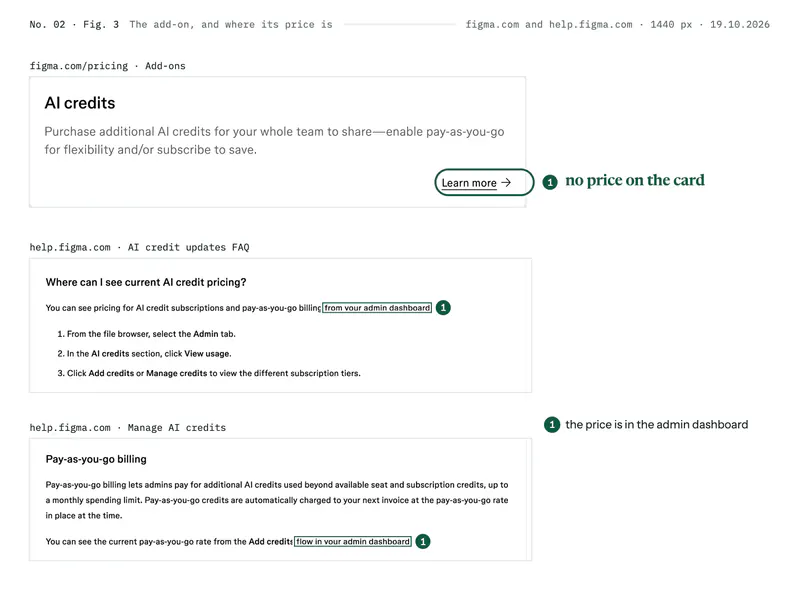
- Figma gives each seat its credits: 3,000 a month on a Professional Full seat, 500 on Collab and Dev seats. The pricing page names an AI credits
add-on , with no price (source 2). When I reviewed Figma Make on 19 October 2026, a buyer couldn’t find what a typical prompt costs (source 7).
So publish both rates: what a credit costs, and what an action uses, as a typical figure and a ceiling.
A fixed part and a moving part
Model prices move, some on known dates: prices have dates. GitHub’s split is one answer. Since 1 June 2026, each plan’s base credits are pegged one to one to its price and stay the same; the flex allotment on top is variable, so it can follow the cost of AI (source 8). The buyer knows the floor, and the seller keeps room to move.
Per outcome: define the outcome
Intercom charges US$0.99 for each outcome of its Fin agent. An outcome counts when the customer confirms the issue is resolved, when they stop asking after Fin answers, or when Fin finishes a workflow, handoffs included. It is charged once a conversation, and on another help desk a minimum monthly commitment applies (source 4). Salesforce also sells Agentforce at US$2 a conversation (source 3).
The lesson is the definition, not the price. If the page doesn’t say which events are billed, the buyer can’t budget, and every invoice becomes a question.
Price top-ups from the cost
A
| Line | US$ |
|---|---|
| One action, to you | 0.011 |
| A pack of 1,000 actions, to you | 11 |
| Price, if the model takes 25% of it | 44 or more |
| Price, if the model takes 10% of it | 110 or more |
Sell the pack in the buyer’s unit (actions, documents, conversations), and turn it into credits only when one currency has to pay for several features. Open 1,000 actions in the AI cost check and try your own model.
Four lines the pricing page owes
- The unit: a seat, a credit, an action or an outcome, defined in one sentence.
- What each plan includes, in that unit, on the plan’s card.
- What happens at the limit: it stops, slows, waits for the reset, or bills on.
- The price of more, on the pricing page itself, not only in a help article or an admin screen.
Checks C4 and C5 of the pricing-page checklist test a page for lines 2 to 4. For a page that misses the fourth, see the Figma Make teardown, change 1.
When the plans have to change
The pricing and checkout teardown reads how your AI features are packaged or metered, beside your plans, upgrade paths and trials, and ends with two or three experiments to run.
Sources
- GitHub Docs, “Usage-based billing for individuals”, docs.github.com, read on 25 October 2026: what an AI credit is worth, base credits and flex allotments on Pro, Pro+ and Max, no carry-over, and code completions outside credits. The page shows no last-updated date.
- Figma, “Pricing”, figma.com/pricing, read on 25 October 2026: AI credits a month by seat and plan, and the AI credits
add-on , named without a price. - Salesforce, “Agentforce pricing”, salesforce.com/agentforce/pricing, read on 25 October 2026: Flex Credits, the credits an action uses, and the price per conversation.
- Intercom, “Pricing”, intercom.com/pricing, read on 25 October 2026: Fin’s price per outcome, what counts as an outcome, one charge a conversation, and the minimum commitment on another help desk.
- Notion, “Pricing”, notion.com/pricing, read on 25 October 2026: the plans that include Notion AI’s features, and Custom Agents priced in Notion credits.
- Anthropic, “Pricing”, platform.claude.com/docs/en/about-claude/pricing, read on 25 October 2026: Claude Sonnet 5.5 at US$2 per million input tokens and US$10 per million output tokens, as on 20 October.
- quietlybuild, “Teardown: Figma Make and its AI credits”, quietlybuild.in/teardowns/figma-make-ai-credits, captured on 19 October 2026: changes 1 to 3.
- Joe Binder, “GitHub Copilot individual plans: Introducing flex allotments in Pro and Pro+, and a new Max plan”, github.blog, 12 May 2026, read on 25 October 2026: usage-based billing from 1 June 2026, base credits pegged to the price, and the flex allotment’s purpose.
Not affiliated with any company named here. Prices are each company’s list prices on the day shown, in US dollars, before tax: not a quote, and not financial advice.
What changed in this guide
- 25 October 2026. Written. Every price was read that day on each company’s own page.