Teardown No. 04 · Attio · pricing page
Ten changes to Attio’s pricing page
Where a buyer has to work out what the AI credits buy.
Captured Not affiliated with Attio
Changes01: Say what a credit buys, on the page02: Say in the table who spends which credits03: Say what happens when credits run out
Attio is a CRM from Attio Ltd, London. Its pricing page sells four plans per seat, and pays for AI with two pools of credits on top. I read it on Tuesday 27 October 2026, at 1440 px and 390 px wide, and wrote down what I would change, in order.
Much of it works. Each card is short: a price, who it is for, three features. One switch moves every price between Annual and Monthly, the credit packs included. The FAQ is brief, and the help article it links to gives real examples of what credits cost. These changes are about the gap between the two: what a buyer can learn about credits without leaving the page.
Want one for your page? A Teardown: US$950, 5 working days
Ten changes, in order
Change 1: Say what a credit buys, on the page
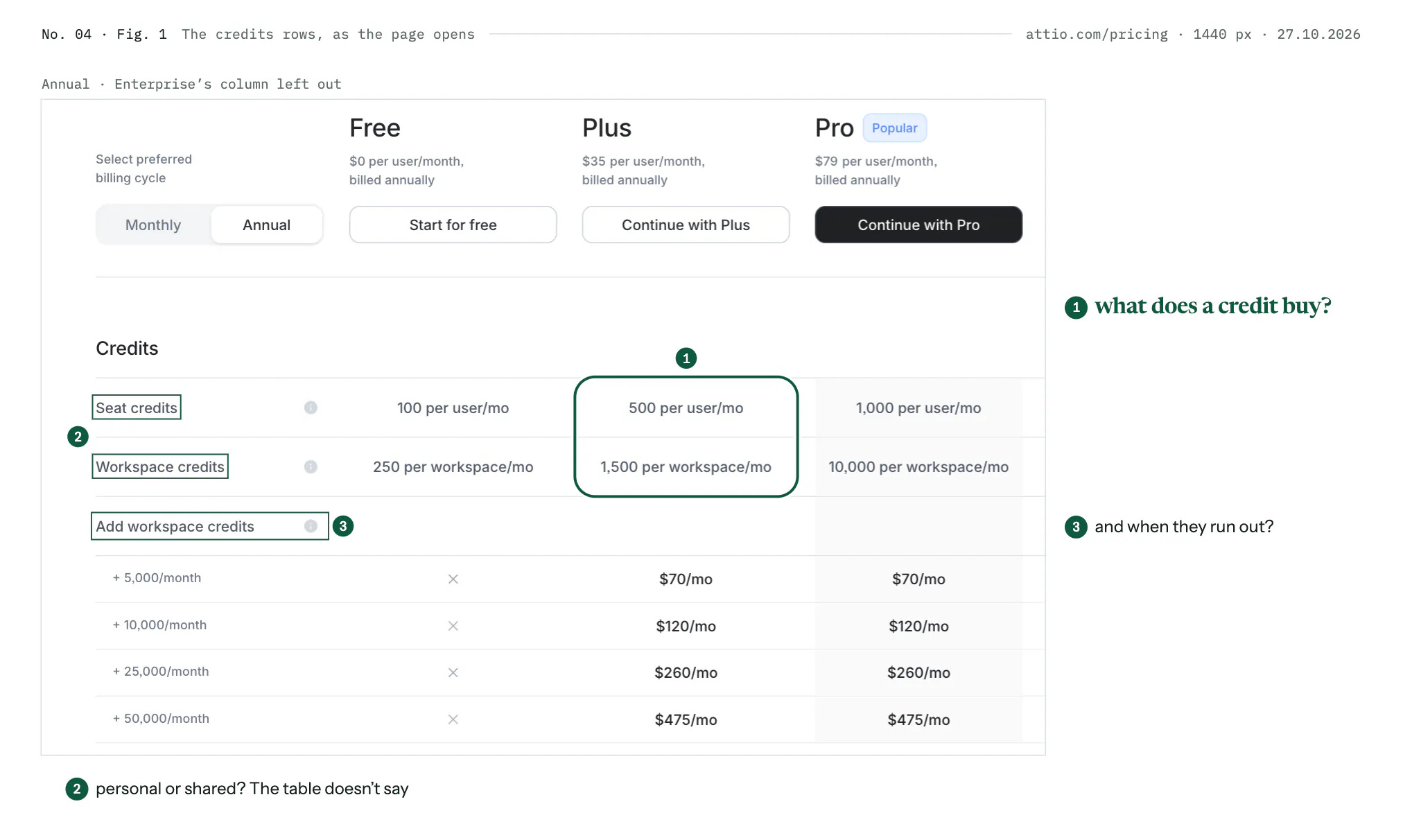
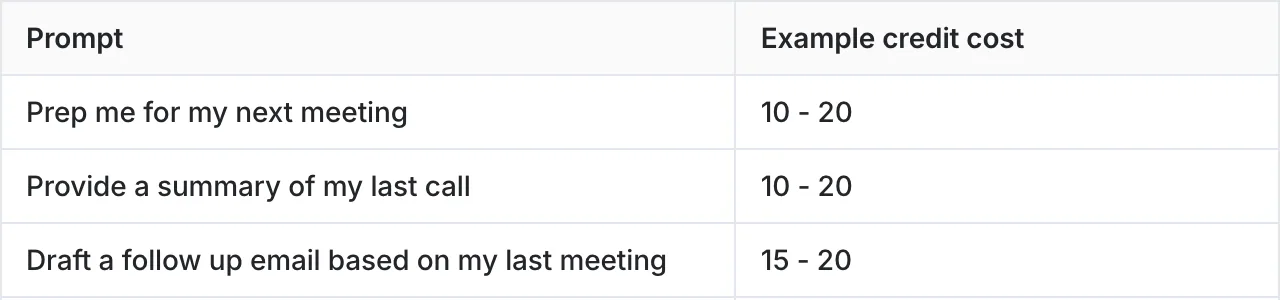
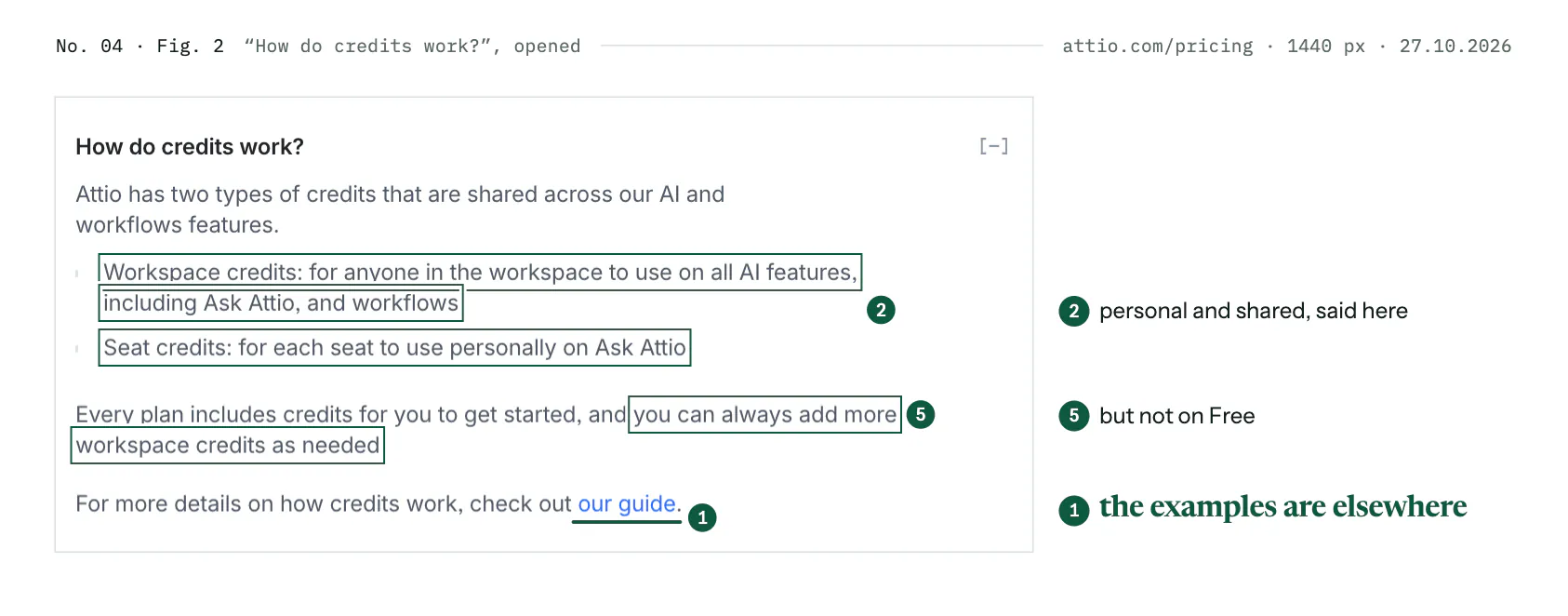
Seen. Every plan gets an allowance: 100 to 2,500 seat credits per user a month, and 250 to 10,000 workspace credits (Custom on Enterprise). Paid plans can add packs of 5,000 to 50,000 more (Fig. 1). Nothing on the page says what one credit buys. The FAQ ends “For more details on how credits work, check out our guide” (Fig. 2). That help article has the examples: “Prep me for my next meeting” costs 10 to 20 credits on the Auto model (the inset), and a workflow step that creates or updates a record costs 1.
Why it matters. A team choosing between Plus’s 1,500 workspace credits and Pro’s 10,000 can’t tell if either is enough without leaving the page, just when it is comparing prices.
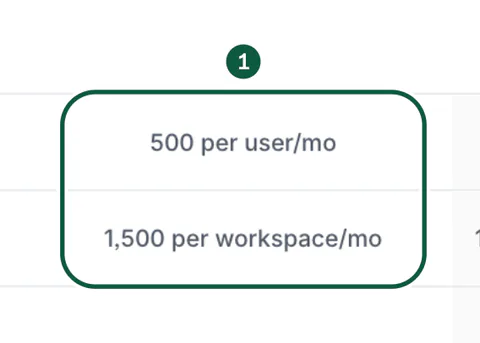 Seen in Fig. 1what does a credit buy?
Try. One line under each credits row, in the article’s own numbers: “A meeting prep in Ask Attio: about 10 to 20 credits.” “A workflow step that writes a record: 1 credit.” Keep the link for the rest.
 , open it full size
Change 2: Say in the table who spends which credits
Seen. The rows read “per user/mo” and “per workspace/mo” (Fig. 1). Their tooltips (read on 27 October 2026, not shown here) say every seat includes monthly credits for Ask Attio, and that monthly credits are included for workspace use on AI and workflows. Only the FAQ, 5,717 px further down, says seat credits are “for each seat to use personally on Ask Attio” and workspace credits are “for anyone in the workspace” (Fig. 2).
Why it matters. In the table they look like two allowances of the same thing. They aren’t: workflows draw only on the shared pool, so a team that plans to automate should compare the workspace row, whatever the seat row says.
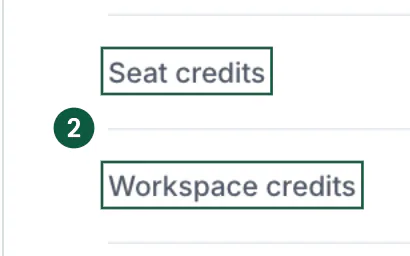 Seen in Fig. 1personal or shared? The table doesn’t say
Try. Put it in the labels: “Seat credits · personal, Ask Attio only” and “Workspace credits · shared, all AI and workflows”.
Change 3: Say what happens when credits run out
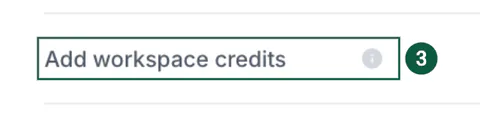
Seen. The pricing page doesn’t say. The nearest line is the tooltip on “Add workspace credits” (Fig. 1 shows the button; the tooltip was read on 27 October 2026, not shown here), which only invites a
Why it matters. On anything metered, “what happens at zero?” is one of the first questions. For Ask Attio the answer is a calm one, a pause and a notice, and the page could use it to reassure.
 Seen in Fig. 1and when they run out?
Try. One line under the credits rows, worded to the real rule, for example: “Out of seat credits? Ask Attio uses workspace credits. Out of both? It pauses until your credits renew or you add a pack.” Then the same for workflows.
 , open it full size
Change 4: On a phone, show what the credit packs cost
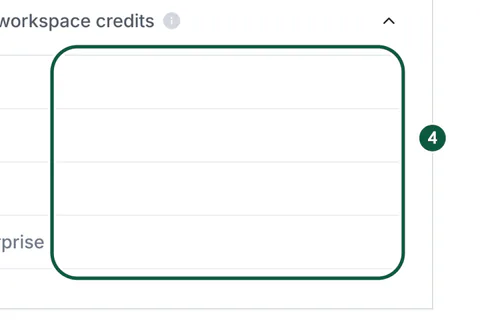
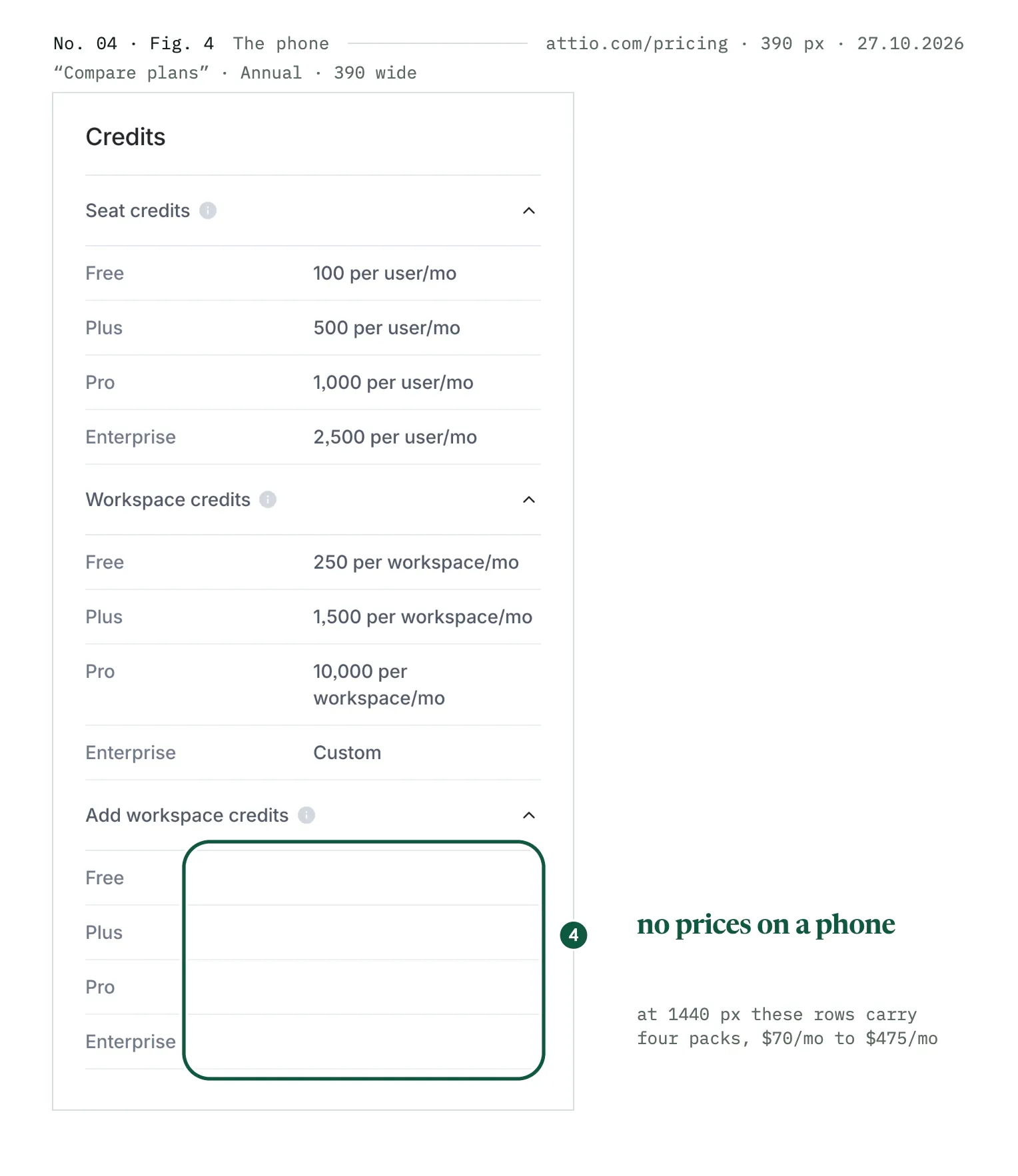
Seen. At 390 px the table becomes a list, “Compare plans”. Under “Add workspace credits” it names Free, Plus, Pro and Enterprise, with nothing beside any of them (Fig. 4). The packs and prices the 1440 px table shows, $70 to $475 a month on Annual, aren’t on the phone page at all. The help article sends readers to this page for them (the inset).
Why it matters. On a phone, a buyer can’t find out what more credits cost: this page doesn’t show it, and the help article sends them back here.
 Seen in Fig. 4no prices on a phone
Try. Under each plan, the four packs as the desktop table has them, and “Not on Free” beside Free.
 , open it full size
Change 5: Make the FAQ agree with the table on top-ups
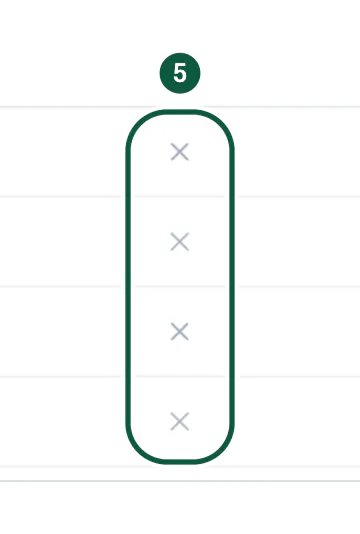
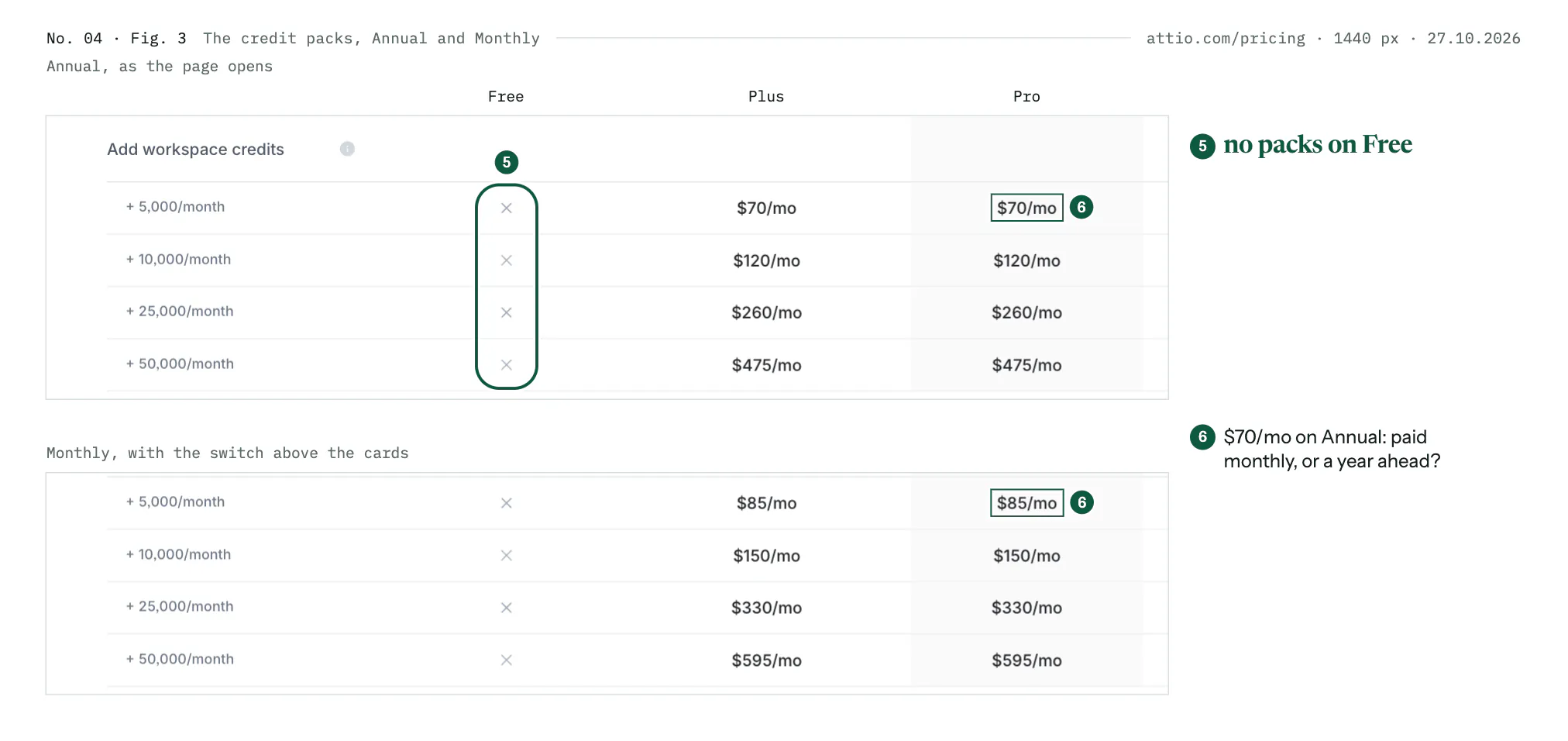
Seen. The FAQ says “Every plan includes credits for you to get started, and you can always add more workspace credits as needed.” (Fig. 2). The table puts a cross against Free in all four pack rows (Fig. 3).
Why it matters. A team on Free that reads the FAQ expects to buy more credits when it runs short, and learns otherwise just when it needs them.
 Seen in Fig. 3no packs on Free
Try. “… and on Plus, Pro and Enterprise you can add more workspace credits as needed.”
Change 6: Say how a credit pack is billed on Annual
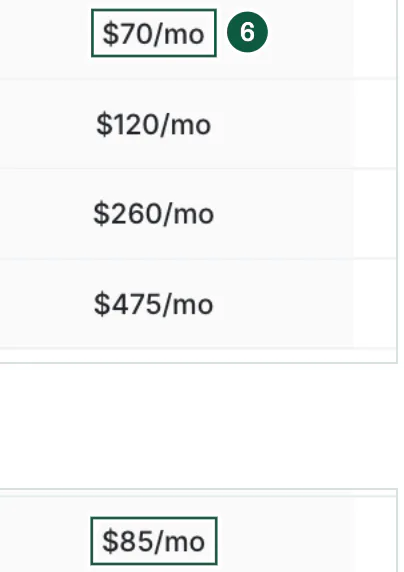
Seen. The packs follow the switch above the cards: “+ 5,000/month” is $70/mo on Annual and $85/mo on Monthly, and the other three move the same way (Fig. 3). Both read “/mo”. The cards say “Per user/month, billed annually”; the packs say nothing about billing.
Why it matters. A buyer on Annual can’t tell whether a $70 pack goes on the yearly invoice, $840 at once, or is charged each month.
 Seen in Fig. 3$70/mo on Annual: paid monthly, or a year ahead?
Try. Write it as the cards do. If that is the rule: “$70 a month, billed annually ($840)”.
Change 7: Name the trial on the cards
Seen. The FAQ says “Attio has a
Why it matters. Fourteen days of Pro is the strongest reason to try it, and it isn’t on Pro’s card. A team choosing between Plus and Pro decides without it.
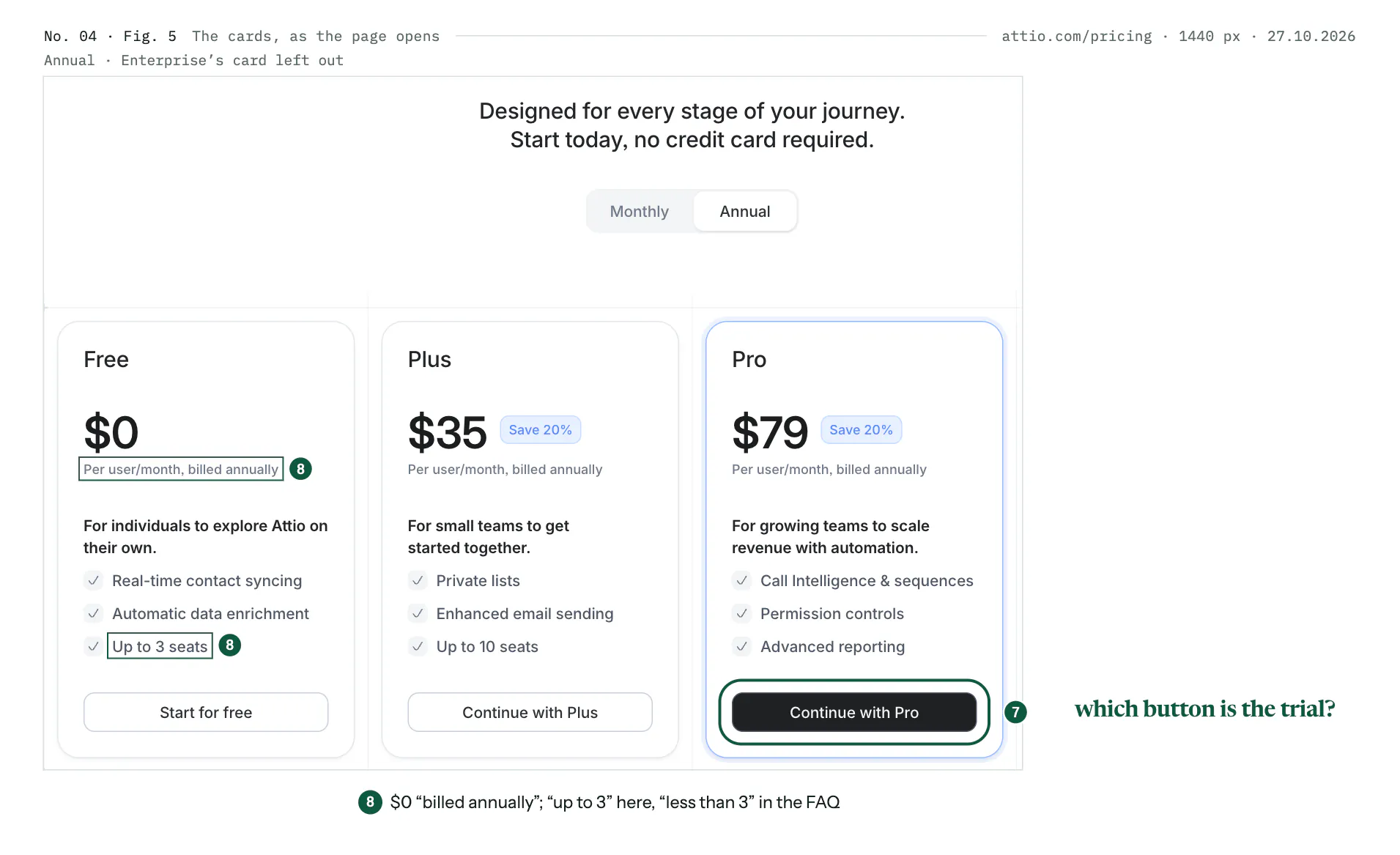
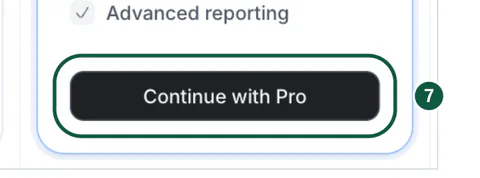 Seen in Fig. 5which button is the trial?
Try. On Pro’s button, “Try Pro free for 14 days”, with “No credit card” under it, if that is how the trial starts. If it starts another way, say how, on the card.
 , open it full size
Change 8: Make Free’s card say what Free is
Seen. At $0, Free’s card reads “Per user/month, billed annually” as the page opens (Fig. 5). It allows “Up to 3 seats”. The FAQ says Free is for teams of “less than 3” (the inset).
Why it matters. Nothing is billed on Free, so a billing line makes a free plan read like a commitment. And “up to 3” and “less than 3” differ by one person: the third teammate.
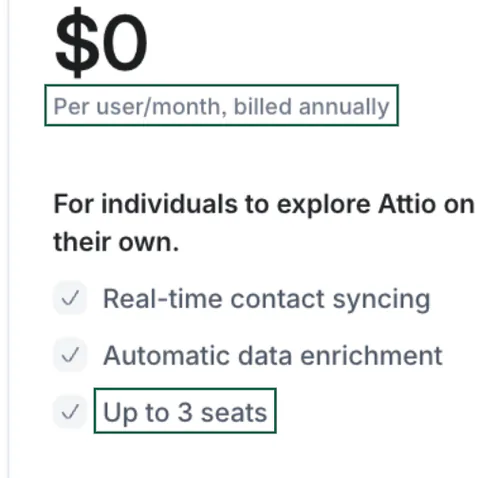 Seen in Fig. 5$0 “billed annually”; “up to 3” here, “less than 3” in the FAQ
Try. “Free for up to 3 seats” in place of the billing line, and the same words in the FAQ.
 , open it full size
Change 9: Say on the AI rows that they use credits
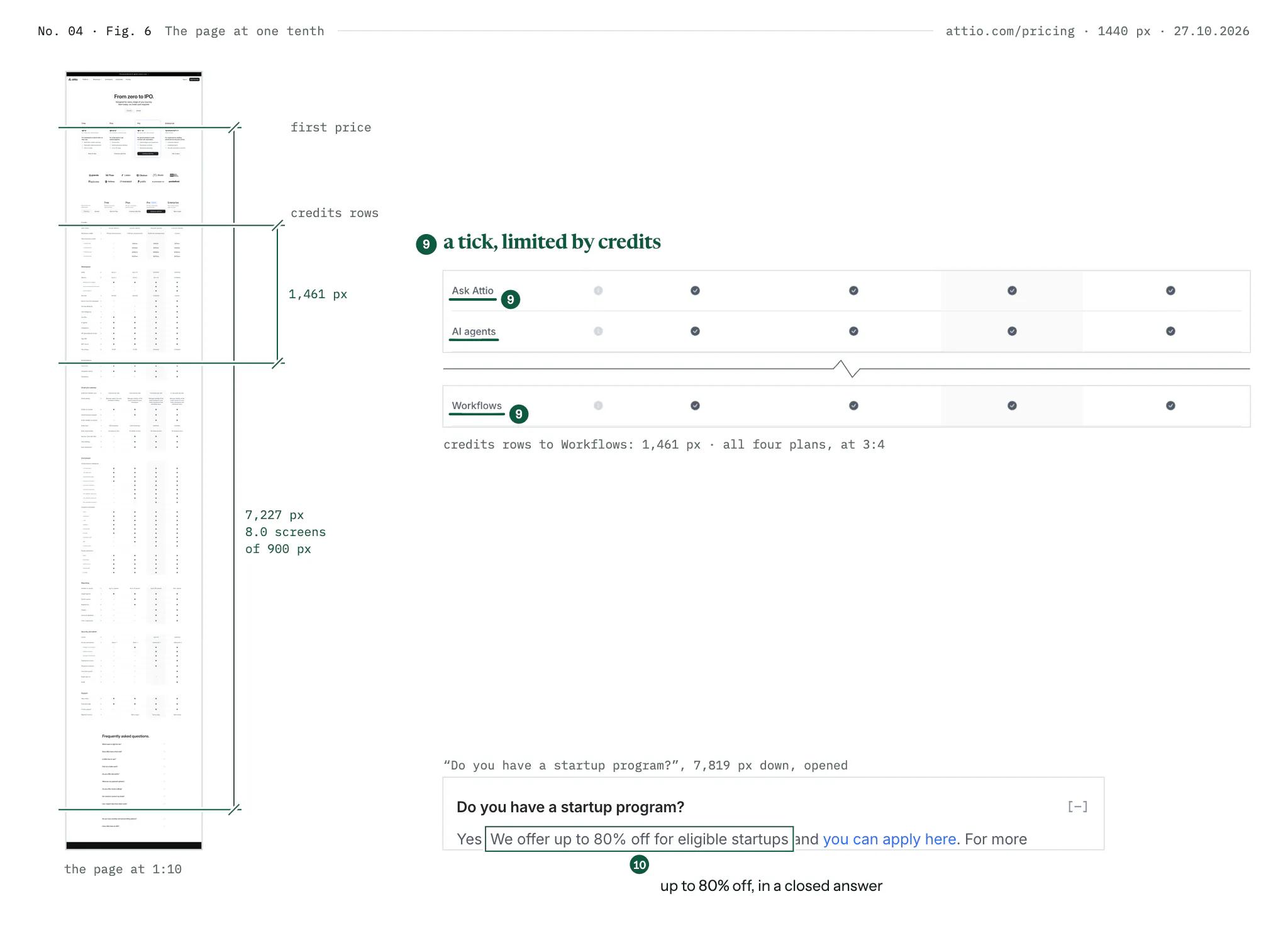
Seen. “Ask Attio”, “AI agents” and “Workflows” are ticked on all four plans (Fig. 6). Their tooltips (read on 27 October 2026, not shown here) describe AI chat, AI agents and automations, and don’t mention credits. Workflows sits 1,461 px below the credits rows.
Why it matters. A tick reads as “included”. How much is included is set by the credits rows, a screen and a half higher.
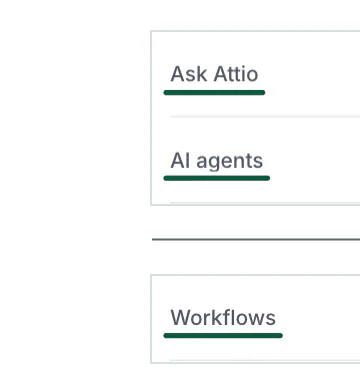 Seen in Fig. 6a tick, limited by credits
Try. Add “Uses credits” to those three tooltips, with a link up to the credits rows.
Change 10: Bring the startup discount up to the cards
Seen. “Do you have a startup program?” is near the foot of the FAQ, 7,227 px below the first price, and closed. Opened, it says “We offer up to 80% off for eligible startups” (Fig. 6). The Platform menu at the top and the footer link to “Startup program”, without saying what it offers. Near the cards, nothing mentions it.
Why it matters. The headline is “From zero to IPO.” For teams at zero, the biggest price fact on the page is behind a click at its foot.
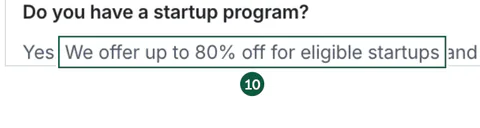 Seen in Fig. 6up to 80% off, in a closed answer
Try. One line under the switch: “Startups: up to 80% off. See if you qualify”, linking to the programme’s page.
six figures · 1440 and 390 px · captured 27.10.2026
The changes, on the page
Each change is framed and carries its number from the list above; the one that matters most in each figure is ringed or underlined in green. Green figures in mono were measured on the page. Fig. 2, Fig. 3 and Fig. 6 show states reached with the page’s own controls: an FAQ answer opened, and the switch set to Monthly. Each figure opens full size.
 , open it full size
Changes01: Say what a credit buys, on the page02: Say in the table who spends which credits05: Make the FAQ agree with the table on top-ups
 , open it full size
Changes05: Make the FAQ agree with the table on top-ups06: Say how a credit pack is billed on Annual
 , open it full size
 , open it full size
Changes07: Name the trial on the cards08: Make Free’s card say what Free is
 , open it full size
Changes09: Say on the AI rows that they use credits10: Bring the startup discount up to the cards
Tests · Suggested, not run
What I’d test first
1The credits, explained in the table (changes 1, 2 and 3). Show half of new visitors today’s credits rows, and half the same rows with their labels, one example each and the line on running out. Measure paid starts on Plus and Pro, and the share that choose Pro. Watch “Talk to sales” requests as the guardrail. Agree beforehand the smallest change worth acting on, and run for at least two full weeks.
2The trial on Pro’s button (change 7). Show half of new visitors “Try Pro free for 14 days”. Measure Pro trials started and, once they have ended, how many became paid Pro. Watch Plus sign-ups as the guardrail. Changes 4, 5 and 8 need no test: they make the page agree with itself.
The record27.10.2026
- No.
- 04
- Subject
- Attio
- Page or flow
- pricing page, attio.com/pricing
- Region
- UK
- Captured
- , at 1440 and 390 px
- Published
- Inside
- ten changes, in order · six figures · five insets
Public pages only, as seen on the date. Not affiliated with Attio.
Free: the pricing-page checklist, with examples from the teardowns, and the pricing page self-check to print.
How it was read · Public pages only
Method and limits
- Public page only. No inside data, not affiliated.
- What I looked at. The public page attio.com/pricing, as a visitor who was not signed in, on Tuesday 27 October 2026 between 10:03 and 10:42 UTC, from India. Prices were shown in US dollars. The same morning I read the help article its credits answer links to, “Manage workspace and seat credits”.
- How. Screenshots in headless Google Chrome at 1440 px and 390 px wide. A short script used the page’s own controls, as a visitor would: the Monthly switch, the tooltips on the table’s rows, and four FAQ answers. The buttons’ addresses were read, not followed.
- Measured. Every position and distance from the page’s layout, in CSS pixels. The sums ($70 × 12, 7,227 / 900) are mine.
- What I did not do. No account, no trial, no form and no contact with Attio. A consent panel appears on a first visit. No choice was made in it, and it is cropped out of every figure.
- What I don’t know. Attio’s traffic, conversion rates, test history or plans, or why the phone list leaves the packs out. Some of these changes may already have been tried.
- Limits. The page may differ by country, by visitor and over time. A banner at its top read “The new architecture for agentic revenue is here”, so it may be changing. The figures show the page as captured on the date above, not as it is today.
- Not affiliated. I have no connection with Attio, and Attio has not reviewed this. Attio is a trademark of Attio Ltd.
Sources
- Attio, “Plans & Pricing”, attio.com/pricing, read on 27 October 2026, with its comparison table and the tooltips on its rows, and its FAQ answers on choosing a plan, the free trial, credits and the startup programme.
- Attio Help Center, “Manage workspace and seat credits”, attio.com/help, read on 27 October 2026: seat credits are used first, what happens at the limit, example credit costs for Ask Attio and for workflow blocks, and where the packs are priced.
- Attio, “Privacy Policy”, attio.com/legal/privacy, read on 27 October 2026: Attio Limited; and Companies House, Attio Limited, company 10719702, find-and-update.company-information.service.gov.uk, read the same day: registered in London.